In this article: Why title verification matters | Documents that prove clear title | Encumbrance certificate explained | Title verification checklist | Common title defects to watch for | Who should verify — you, or a lawyer? | RERA vs resale documentation | 10 FAQ
Property Documentation Checklist: Verifying Title Before You Buy in Jaipur
The single most expensive mistake in property buying isn't overpaying — it's buying a property with a title dispute you didn't catch. A clean-looking flat with a compromised legal title can tie up your money and your ownership for years, long after the excitement of moving in has worn off. Most buyers know they "should" check documents, but very few actually know which documents matter and what to look for in each one.
This guide breaks down exactly what "clear title" means, which documents prove it, and a practical checklist you can actually use — whether you're buying under-construction, ready-to-move, or resale property.
Why Title Verification Actually Matters
"Clear title" means the seller genuinely owns the property, has the legal right to sell it, and there are no competing claims, unpaid loans, or legal disputes attached to it. A property can look completely normal — occupied, well-maintained, professionally marketed — while carrying a title defect that only surfaces during registration, or worse, years after you've moved in.
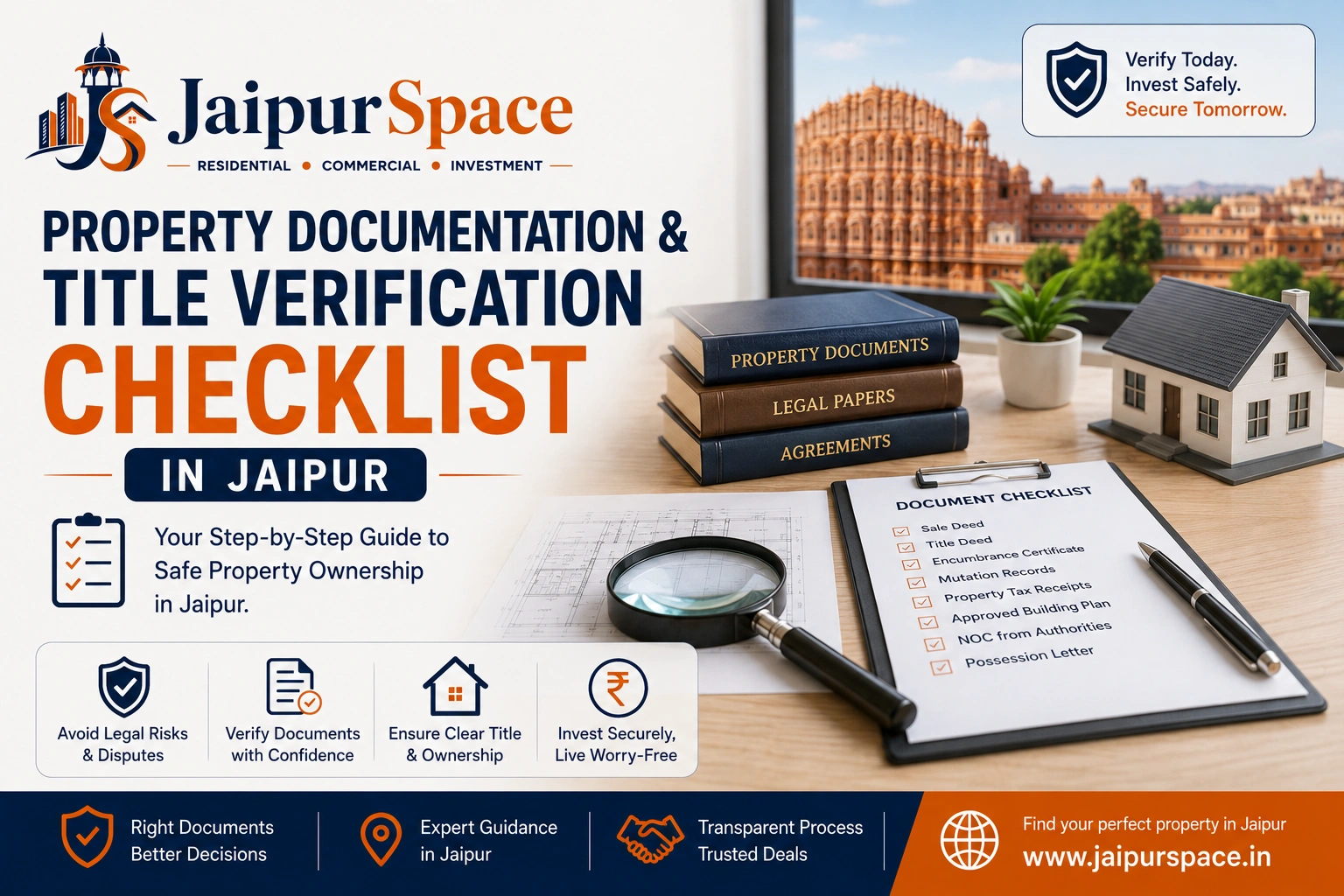
Core Documents That Prove Clear Title
| Document | What It Proves |
|---|---|
| Sale deed (previous chain) ✅ | The unbroken ownership history — each transfer from one owner to the next, ending with the current seller |
| Encumbrance certificate ✅ | No registered mortgages, liens, or legal claims against the property for the period covered |
| Mutation records (Jamabandi/property register) | The property is officially recorded under the current owner's name in municipal/revenue records |
| Property tax receipts | Taxes are current, and the paying party matches the claimed owner |
| Approved building plan / sanctioned layout | Construction matches what was legally approved, not an unauthorized addition |
| Occupancy Certificate (for ready properties) | Construction is complete and legally fit for possession |
| RERA registration (for under-construction) | The project itself is legally registered and escrow-protected |
Title Verification Checklist
| Check | Why It Matters |
|---|---|
| Complete chain of sale deeds, no gaps | Any missing link in ownership history is a red flag ✅ |
| Encumbrance certificate shows "nil" for the covered period | Confirms no outstanding mortgages or legal claims |
| Seller's name matches all documents exactly | Name mismatches across documents can signal deeper ownership issues |
| Property tax paid up to date | Unpaid dues can become the buyer's liability after purchase |
| No pending litigation on the property | Court records should be checked for any active disputes |
| Approved plan matches actual construction | Unauthorized construction can complicate registration and future resale |
| For under-construction: RERA number verified independently | See our complete RERA verification guide |
Common Title Defects to Watch For
- Broken chain of ownership — a gap between one recorded sale and the next, with no clear document bridging them.
- Unregistered prior sale — a property sold informally without proper registration, creating an unclear legal owner.
- Disputed inheritance — property passed down without formal succession documentation, especially when multiple heirs are involved.
- Undisclosed mortgage — an existing loan against the property that the seller hasn't disclosed, which the encumbrance certificate should reveal.
- Unauthorized construction — built area exceeding what was legally sanctioned, which can complicate both registration and future resale.
Who Should Verify — You, or a Lawyer?
Basic checks (matching names across documents, confirming an encumbrance certificate exists and shows "nil," verifying tax receipts) are things any buyer can reasonably do themselves. However, a proper legal title search — particularly for resale properties with a longer ownership history, or any property involving inherited land — is worth having a property lawyer review formally. The cost of legal verification is small relative to the risk of an undiscovered title defect.
RERA Projects vs Resale: Documentation Differs
| Factor | RERA-Registered New Project | Resale Property |
|---|---|---|
| Title complexity | Simpler — single chain from developer ✅ | Can involve a longer, more complex ownership history |
| RERA registration check | Required and verifiable ✅ | Not applicable directly, though original project registration may still be relevant |
| Encumbrance certificate need | Still worth checking on the land itself | Essential — longer history means more potential claims ✅ |
| Builder warranty on structure | Applies — 5-year structural liability ✅ | Typically none — property is sold "as is" |
What Does Documentation Verification Cost?
Costs vary depending on whether you handle basic checks yourself or engage a property lawyer for a formal title search. Obtaining an encumbrance certificate and certified copies of prior sale deeds from the registrar's office typically involves modest government fees. A formal legal title search, if you choose to engage a lawyer, costs more but provides a documented professional opinion — genuinely worthwhile for resale properties with a longer or more complex ownership history, where the stakes of missing something are higher.
Documentation Needs by Property Age
| Property Type | Documentation Focus |
|---|---|
| New RERA-registered project | RERA registration verification, developer's land title, approved building plan ✅ |
| Recently completed (under 5 years) | Occupancy certificate, original developer sale deed, property tax records |
| Older resale (5-15 years) | Full encumbrance certificate, complete sale deed chain, mutation records ✅ |
| Older resale (15+ years) or inherited property | Extended encumbrance history, succession/inheritance documentation, more thorough legal review recommended ✅ |
The general pattern: the older and more complex a property's ownership history, the more thorough your documentation review should be. A brand-new RERA-registered project from a reputable developer typically presents far less title complexity than a decades-old resale property that's changed hands multiple times.
Frequently Asked Questions
What's the single most important document to check?
The encumbrance certificate — it's the clearest, most direct evidence of whether financial or legal claims exist against the property. Combined with a complete, unbroken sale deed chain, these two documents catch the vast majority of real title issues.
How far back should an encumbrance certificate cover?
At least 13 years is standard practice — long enough to capture most relevant historical claims while remaining a practically obtainable record from the registrar's office.
Is title verification different for under-construction properties?
Somewhat — the focus shifts to confirming RERA registration and the developer's title to the underlying land, rather than a long resale ownership chain. See our RERA guide for the specific verification steps there.
Can I verify documents myself, or do I need a lawyer?
Basic checks are reasonable to do yourself — but for resale properties with a longer or more complex ownership history, formal legal verification is a worthwhile investment relative to the risk involved.
What if the encumbrance certificate shows a past mortgage?
It's not automatically disqualifying — confirm the mortgage was properly closed and released, with documentation showing the loan was fully repaid and the lien formally lifted before proceeding.
Does Jaipur Space handle documentation verification for buyers?
Yes — every project on our listings is documentation-verified before publishing, and our team supports you through the verification process on any specific unit you're considering, at zero brokerage.
What happens if a title defect is discovered after registration?
This is exactly why pre-purchase verification matters — resolving a title dispute after registration is significantly more complex, costly, and time-consuming than catching it beforehand.
Are mutation records the same as a sale deed?
No — the sale deed is the legal transfer document itself; mutation records reflect that the property has been officially updated in municipal or revenue records to show the current owner. Both matter, and they should be consistent with each other.
Is documentation different for family/joint purchases?
The underlying property documentation is the same regardless of how many buyers are involved — what changes is the buyer-side paperwork, like relationship proof for co-applicants. See our home loan eligibility guide for how family loan applications work.
How long does full documentation verification take?
Timelines vary depending on document availability and complexity, but starting verification early — well before you're ready to register — avoids it becoming a bottleneck at the final stage of a purchase.
Buy with Verified Documentation
Every project we list is documentation-checked before publishing. Talk to our team about any property you're considering, and we'll walk you through exactly what's been verified and what still needs your own review.