In this article: What determines eligibility | Salaried vs Self-Employed criteria | How EMI is actually calculated | Documents required (including joint/family loans) | How much you can really borrow | Tips to improve eligibility | Pre-approved vs regular loans | Which loan type fits your profile | 10 FAQ
Home Loan Eligibility & EMI Guide for Jaipur Home Buyers
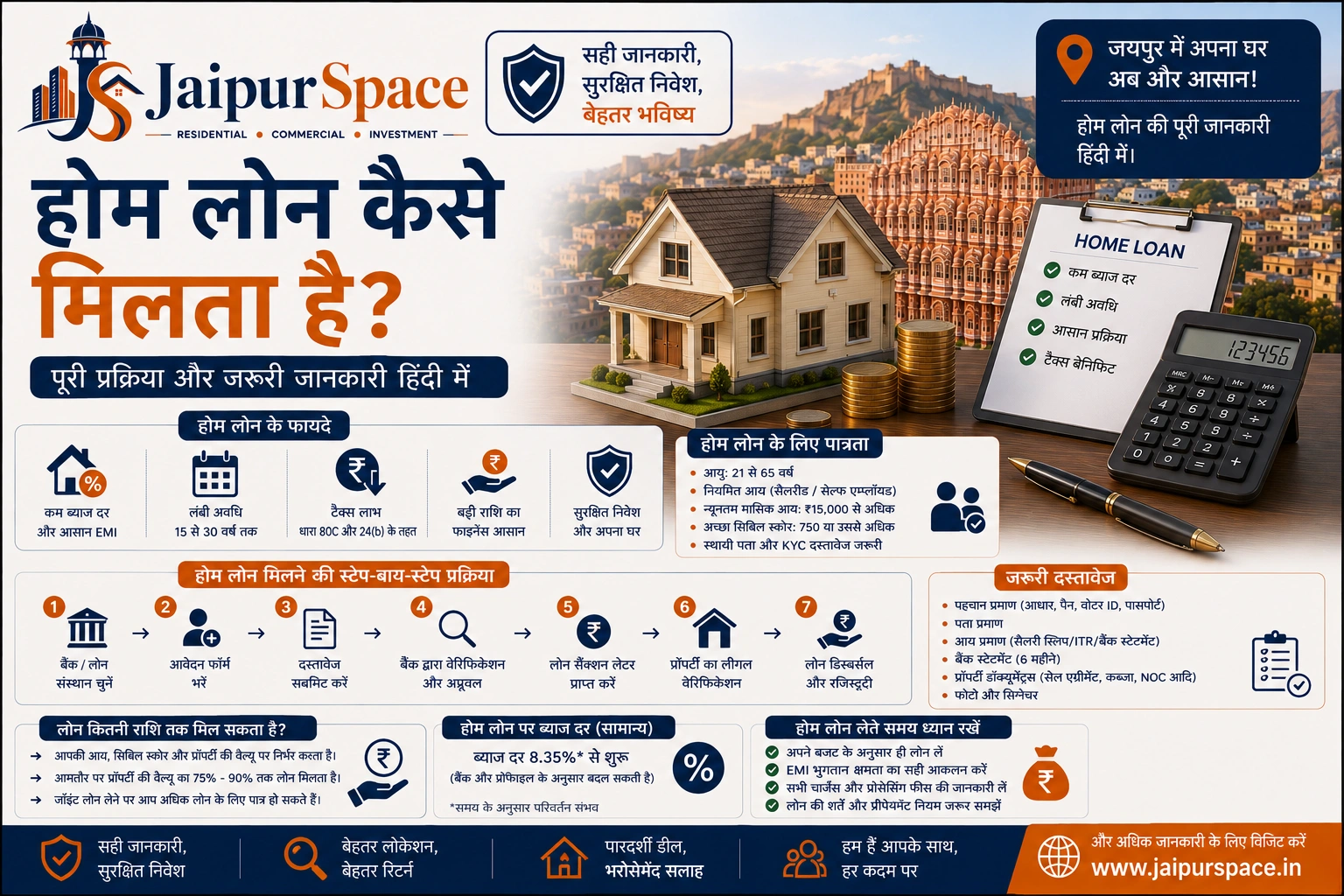
Before you fall in love with a floor plan, the number that actually decides what you can buy is your loan eligibility. Two buyers with identical salaries can qualify for very different loan amounts depending on existing debts, employment type, and how a lender calculates their risk — and most first-time buyers only discover this halfway through a booking.
This guide breaks down exactly how eligibility is calculated, what changes if you're salaried versus self-employed, and how a joint or family application can genuinely change what you qualify for. You can try our own property listings against a real EMI estimate directly on any project page.
What Actually Determines Your Loan Eligibility
Lenders don't just look at income — they calculate what's called your FOIR (Fixed Obligation to Income Ratio): the share of your monthly income already committed to existing EMIs, rent, or other fixed obligations. Most lenders cap total obligations (including the new home loan EMI) at roughly 40-50% of net monthly income for salaried applicants, and slightly more conservatively for self-employed applicants.
| Factor | Salaried Applicants | Self-Employed Applicants |
|---|---|---|
| Primary income proof | Salary slips, Form 16, bank statements | ITR (2-3 years), profit & loss statement, bank statements |
| Typical FOIR cap | ~50% ✅ (more headroom) | ~45% (assessed more conservatively) |
| Income basis for calculation | Net monthly salary + other declared income | Average net profit across available ITR years |
| Employment stability check | Years in current job | Years in business, GST registration, turnover trend |
| Processing speed | Generally faster ✅ | Slightly longer — more documents to verify |
Documents Required — By Loan Type
| Document | Salaried | Self-Employed / Business | Family / Joint Loan |
|---|---|---|---|
| KYC (PAN, Aadhaar, photo) | Required | Required | Required for every applicant ✅ |
| Income proof | Salary slips + Form 16 | ITR + P&L statement | Per applicant, matching their employment type |
| Bank statements | Last 6 months | Last 6-12 months (business account) | Per applicant |
| Business proof | Not applicable | GST registration, business registration | For any self-employed co-applicant |
| Relationship proof (joint) | Not applicable | Not applicable | Required — for co-applicant/guarantor status ✅ |
| Property documents | Sale agreement, title documents | Sale agreement, title documents | Same, regardless of applicant structure |
How Much Can You Actually Borrow?
As a rough starting point, most lenders will extend a loan where the resulting EMI doesn't exceed 40-50% of your net monthly income after accounting for existing obligations. A family or joint application changes this calculation meaningfully:
- Individual applicant: eligibility is capped by one person's income and existing EMIs alone.
- Co-applicant (spouse, parent, sibling): their income is added to the combined eligibility calculation — a genuinely higher loan amount becomes possible.
- Guarantor: doesn't add income to the calculation, but strengthens the application with additional collateral or creditworthiness backing.
We build loan quotations across all three structures — individual salaried, self-employed/business income, and family/joint applications — so the number you're shown reflects your actual household situation, not just one payslip.
Pre-Approved vs Regular Home Loans
| Factor | Pre-Approved Loan | Regular Loan (after property selection) |
|---|---|---|
| When you apply | Before finalizing a property ✅ | After signing an agreement |
| Negotiating power with builder | Stronger — proves serious buying intent ✅ | Standard |
| Processing speed once property is chosen | Faster — most verification already done ✅ | Full process from scratch |
| Validity period | Typically 3-6 months | Not applicable |
| Best suited for | Active buyers comparing multiple projects | Buyers who've already decided on a specific unit |
Tips to Improve Your Loan Eligibility
- Clear or reduce existing EMIs before applying — every existing obligation directly lowers your FOIR headroom.
- Add a co-applicant with steady income — a working spouse or parent can meaningfully raise the combined eligible amount.
- Maintain a healthy bank balance for at least 6 months before applying — this matters especially for self-employed applicants assessed on banking patterns.
- Choose a longer tenure if the EMI-to-income ratio is tight — it lowers the monthly obligation, improving eligibility calculations.
- Keep your credit score healthy — timely repayment history on existing credit directly affects the rate and amount a lender is willing to offer.
Which Loan Structure Fits Your Situation?
| Your Situation | Recommended Approach |
|---|---|
| Single salaried income, straightforward case | Individual salaried application ✅ |
| Business owner with fluctuating annual income | Self-employed application, averaged over available ITR years ✅ |
| Household income needed to reach target property price | Family/joint application with a working co-applicant ✅ |
| Strong income but thin credit history | Add a guarantor to strengthen the application ✅ |
| Actively comparing multiple projects | Get pre-approved before shortlisting ✅ |
Frequently Asked Questions
What's the minimum salary needed for a home loan in Jaipur?
There's no single fixed minimum — eligibility depends on the FOIR calculation against the specific loan amount and tenure you're targeting, not a flat salary threshold. A lower income can still qualify for a smaller loan amount or longer tenure; the property price and your eligible loan amount need to align, not the other way around.
Can self-employed buyers get the same loan amount as salaried buyers?
Potentially, yes — but the assessment is more conservative and based on averaged net profit across 2-3 ITR years rather than a fixed monthly salary. Consistent, well-documented income with healthy bank balances significantly improves self-employed eligibility.
Does adding a co-applicant always increase my loan amount?
Only if the co-applicant has their own qualifying income — adding a co-applicant with no income doesn't change the eligibility calculation, though it can still help as a formal joint owner or for other application reasons.
What's the difference between a co-applicant and a guarantor?
A co-applicant's income is added directly into the combined eligibility calculation, and they become a joint borrower on the loan. A guarantor doesn't contribute income to that calculation but backs the loan with their own creditworthiness or pledged collateral — useful when an applicant's profile needs strengthening without changing whose income counts.
How long does home loan approval take?
Timelines vary by lender and how complete your documentation is at submission — pre-approved applications tend to move faster once a specific property is finalized, since most verification is already done.
Can I get a loan for an under-construction property?
Yes — disbursal happens in tranches tied to construction milestones rather than as one lump sum. See our under-construction listings and full comparison in our Under Construction vs Ready-to-Move guide.
Is it better to choose a longer or shorter loan tenure?
A longer tenure lowers your monthly EMI but increases total interest paid over the loan's life. A shorter tenure costs more monthly but saves substantially on total interest. The right choice depends on your monthly cash flow comfort versus your goal of minimizing total cost.
Do you charge any fee for loan facilitation?
No — zero brokerage on loan facilitation, same as on the property itself. We compare options across our banking partner network and help you get a genuinely suitable quotation, at no extra cost to you.
Can NRIs apply for home loans on Jaipur properties?
Yes, NRI home loan products exist through most major lenders, typically with some additional documentation (like a Power of Attorney for a local representative). Talk to our team for NRI-specific guidance.
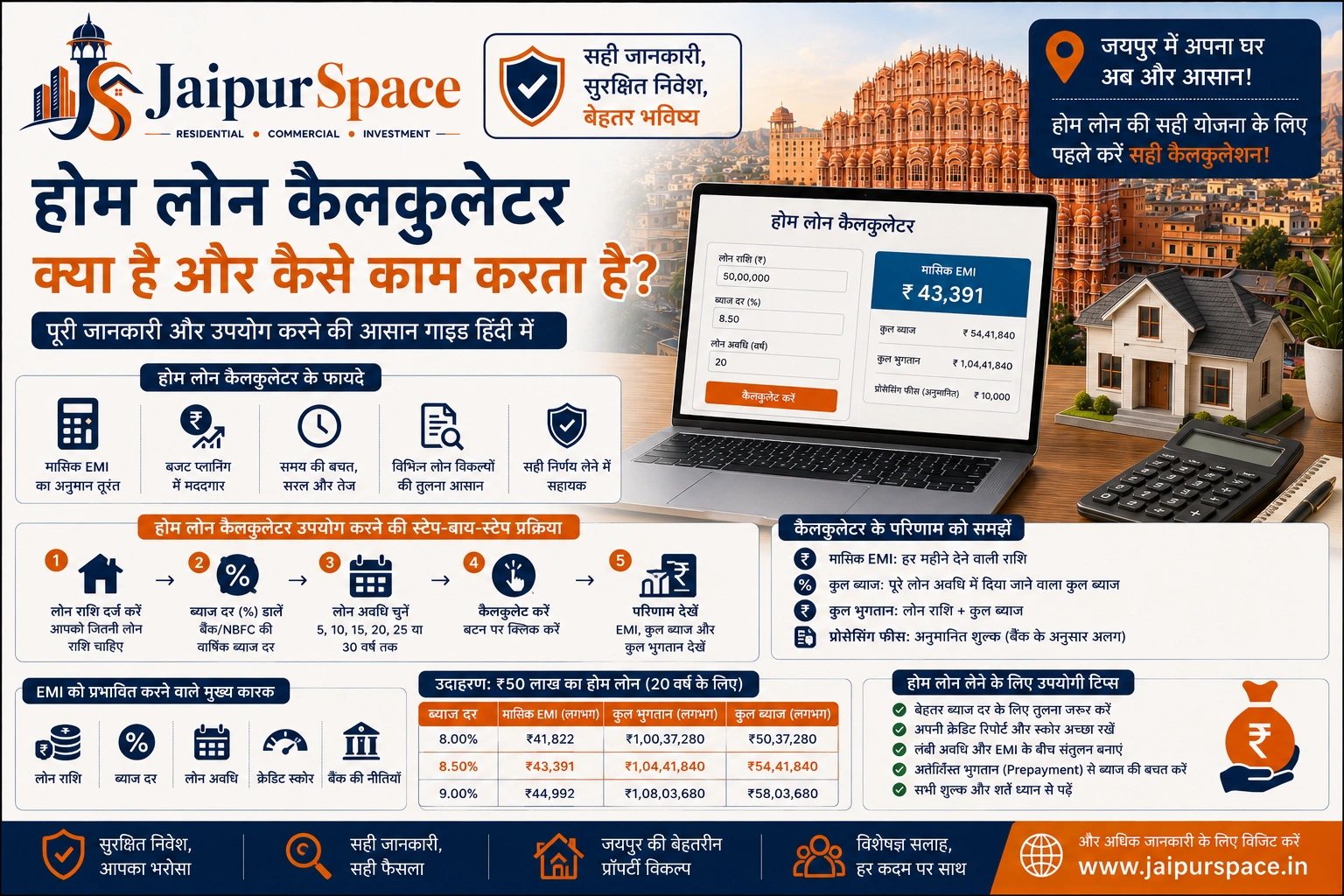
How do I get an accurate EMI estimate before applying?
Every project page on our site includes a live EMI calculator pre-filled with that property's starting price — adjust the loan amount, rate, and tenure sliders to see real numbers instantly. For an exact quotation matched to your actual income profile, request a callback and our loan desk will prepare one.
Ready to Check Your Eligibility?
Get in touch and our team will walk you through a real loan quotation — whether you're salaried, self-employed, or applying as a family — with zero brokerage and full transparency on every number involved.