In this article: What the JDA Master Plan actually is | Why it matters to buyers, not just planners | Zone classifications explained | How to access the current master plan | Master Plan 2025 vs newer versions | What zoning means for your specific plot | Common misunderstandings | 10 FAQ
JDA Master Plan: Complete Guide to Jaipur's Zoning and Development Plan
The JDA Master Plan is the city's official long-term development and zoning document — and while it might seem like something only urban planners need to understand, it actually has genuine practical relevance for property buyers, particularly investors and anyone planning further ahead than their immediate purchase.
What the JDA Master Plan Actually Is
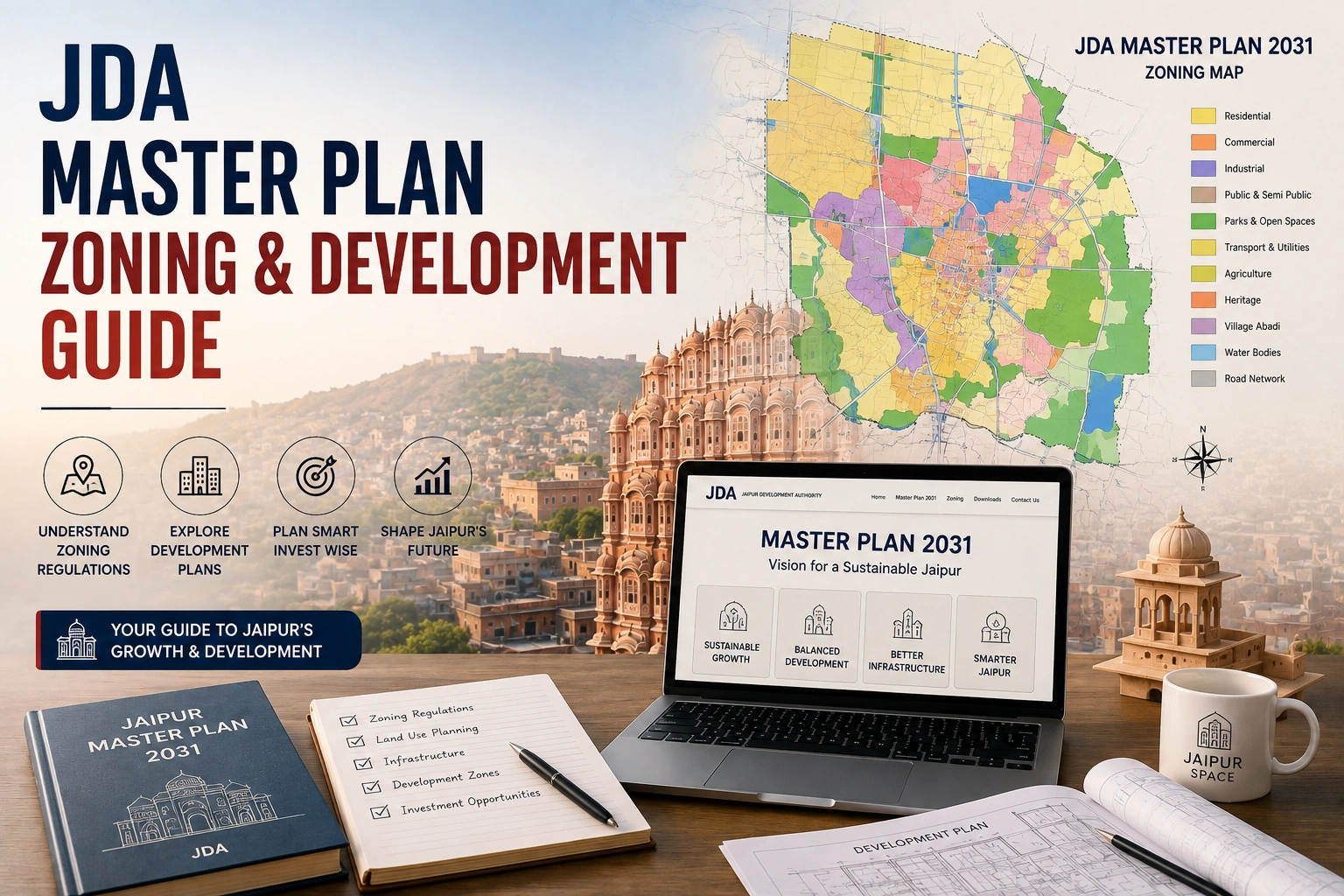
The Master Plan is JDA's official document establishing how land across Jaipur is zoned and how the city's development is intended to proceed over an extended planning horizon — typically spanning decades, with periodic updates and revisions. It covers zone classifications, planned infrastructure, road networks, and the overall vision for how different parts of the city will develop.
Why It Matters to Buyers, Not Just Planners
| Consideration | Why the Master Plan Is Relevant |
|---|---|
| Long-term area development | Understanding a locality's planned trajectory informs realistic appreciation expectations ✅ |
| Zoning compliance | Confirms whether a property's intended use matches its actual zoned classification |
| Planned infrastructure | Future roads, public facilities, or development nearby can meaningfully affect a property's long-term value |
| Investment decision-making | Areas slated for significant planned development can represent different risk/opportunity profiles than already-mature zones |
Zone Classifications Explained
The master plan divides the city into zones with different designated uses — residential, commercial, industrial, and other classifications, each with associated development rules and permitted activities. A property's zone classification affects what can legally be built or operated there, which is directly relevant if you're considering any use beyond standard residential occupancy, or evaluating a property's development potential.
How to Access the Current Master Plan
- Visit JDA's official website — the master plan is generally published as a public document.
- Look for the master plan or planning documents section, which typically offers downloadable versions.
- Confirm you're viewing the current, applicable version — multiple planning horizons (e.g., different target years) may have existed or be referenced, so verify which is currently in force.
- Check for zone-wise breakdowns if available, which can help locate your specific area of interest within the broader document.
Master Plan 2025 vs Newer Versions
Master plans are periodically revised to reflect the city's actual growth and updated priorities — meaning a plan drafted with one target year in mind may be superseded or extended by later revisions. Always confirm you're looking at the currently applicable version rather than an outdated one, since zoning classifications and planned development can genuinely change between revisions.
What Zoning Means for Your Specific Plot
| Zone Type | General Implication |
|---|---|
| Residential | Standard home purchase considerations apply directly ✅ |
| Commercial | Relevant for business/investment property considerations rather than pure residential use |
| Mixed-use or transitional zones | Worth understanding the specific permitted-use details rather than assuming standard residential rules apply |
| Areas slated for future infrastructure | Can represent genuine long-term opportunity, but also potential disruption during actual development phases |
Common Misunderstandings
- "The master plan doesn't affect me, I'm just buying a home" — even standard residential buyers benefit from understanding a locality's planned trajectory for realistic long-term expectations.
- "Current construction always matches official zoning" — not necessarily true, particularly in transitional or older areas.
- "Master plans never change" — they're periodically revised; always confirm the current applicable version.
Master Plan and Growth Corridors Like Jagatpura
Areas experiencing active new development — like Jagatpura, covered in our dedicated locality guide — often reflect master plan priorities around growth and expansion zones. Understanding why a particular corridor has become a development focus, as reflected in planning documents, can add useful context to what you're already observing directly through active new-project supply in that area.
Reading a Zone-Wise Breakdown
When the master plan is presented in zone-wise format, each zone typically corresponds to a defined geographic area with its own designated land-use mix and development parameters. Locating your area of interest within this breakdown — rather than trying to interpret the document as a single undifferentiated whole — makes it considerably more useful for understanding what specifically applies to a location you're evaluating.
Master Plan Documents and Language Access
Given Jaipur's population includes a significant Hindi-speaking base, checking whether current master plan documents are available in Hindi alongside English is worth doing directly on JDA's site — availability can vary by specific document version, and having access in your preferred language makes reviewing detailed zoning information considerably more practical.
The Master Plan's Role in Infrastructure Planning
Beyond zoning classifications, the master plan typically outlines planned road networks, public facilities, and broader infrastructure priorities across the city. For a longer-horizon buyer or investor, understanding whether an area of interest sits within a zone slated for meaningful planned infrastructure investment adds a dimension to the decision beyond current, already-visible conditions alone.
Frequently Asked Questions
Is the JDA Master Plan the same as a specific scheme's development plan?
No — the master plan covers the entire city's zoning and long-term development at a macro level, while individual JDA schemes have their own more granular allotment and layout details.
How often is the master plan updated?
Periodically, on a multi-year planning horizon — always confirm you're referencing the current applicable version rather than an outdated one.
Does the master plan tell me the exact zoning of my specific property?
It should provide zone classification information, often with zone-wise breakdowns, though for definitive confirmation on a specific plot, cross-referencing with JDA directly is worthwhile for anything consequential.
Is the master plan available in Hindi as well as English?
Availability can vary — check the specific document versions offered on JDA's website, as multi-language availability isn't always guaranteed for every document.
Why would an investor care about the master plan specifically?
Understanding planned infrastructure and zoning trajectory helps assess a locality's long-term development potential beyond just current conditions — relevant for anyone making a longer-horizon investment decision.
Can zoning classification change after I've bought a property?
Master plan revisions can, in principle, affect zoning over time — this is exactly why understanding an area's designated trajectory, not just its current status, matters for long-term planning.
Does the master plan cover areas like Jagatpura specifically?
Yes — the master plan covers the full scope of JDA's jurisdiction, including growth corridors like Jagatpura. See our Jagatpura guide for locality-specific context.
Do I need to consult the master plan for a standard home purchase?
Not strictly essential for a straightforward residential purchase in an established zone, but genuinely useful context for understanding a locality's broader trajectory, especially for growth-corridor areas.
Where can I get help interpreting the master plan for a specific property?
Talk to our team — we can help you understand what a property's zoning and locational context within the master plan actually means practically.
Is master plan compliance checked as part of standard property verification?
It's a reasonable additional check alongside our core verification process — see our documentation checklist guide for the broader verification picture.
Can the master plan help me understand future traffic or congestion patterns?
Indirectly, yes — planned road networks and development density outlined in the master plan can inform expectations about how an area's infrastructure and traffic patterns may evolve over the planning horizon, though this requires interpreting the document's infrastructure sections specifically.
Should first-time buyers worry about the master plan at all?
Not as a primary concern — for a standard residential purchase in an already-established, clearly residential-zoned area, the master plan is background context rather than an essential check. It becomes more relevant the further your situation moves toward investment, commercial use, or genuinely long-term planning horizons.
Does the master plan address environmental or green space planning?
Comprehensive master plans typically include some consideration of green spaces and environmental planning alongside residential and commercial zoning — check the specific document sections for this if it's a priority in your evaluation.
Understand the Bigger Picture
Talk to our team about how a property's location fits into Jaipur's broader development trajectory — useful context whether you're buying for now or planning for the long term, and something worth understanding before, not after, you've committed.