In this article: What JDA e-auctions actually are | How the e-auction process works | Registration and eligibility to bid | Understanding auction notices | Deposit and payment requirements | Post-auction process | Risks and considerations specific to auctions | 10 FAQ
JDA e-Auction: Complete Guide to Buying Plots Through JDA Auctions
Beyond private resale and builder-developed projects, JDA periodically auctions plots directly — a distinct acquisition path with its own process, rules, and considerations that differ meaningfully from a standard private property purchase. This guide covers how JDA e-auctions actually work, from finding a notice through to post-auction completion.
What JDA e-Auctions Actually Are
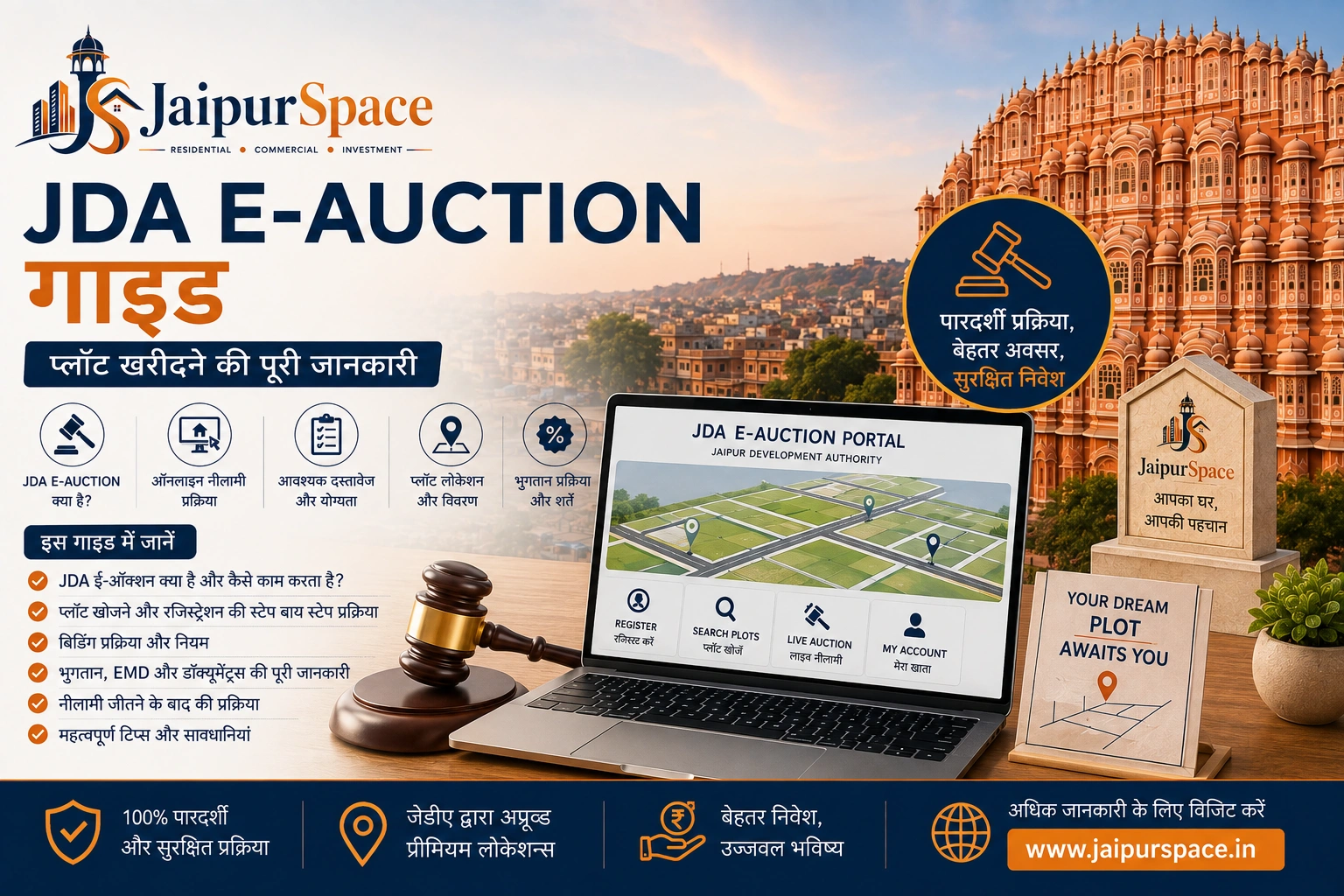
JDA periodically holds public auctions for specific plots under its control — often previously unallotted land, or plots that have reverted to JDA through various administrative processes. These are conducted as transparent, competitive bidding processes, increasingly run through online e-auction systems rather than purely in-person events.
How the e-Auction Process Works
- An auction notice is published — typically on JDA's website and portal, detailing the specific plots available, their location, size, and reserve price.
- Interested bidders register for the auction, meeting whatever eligibility and documentation requirements are specified.
- A refundable earnest money deposit is typically required to actually participate in bidding — establishing serious intent and financial capability.
- Bidding occurs within the specified window, following the format detailed in that specific auction's notice (which can vary — sealed bid, live online bidding, or other formats).
- The winning bidder is determined and notified, with subsequent steps for completing payment and formal allotment.
Registration and Eligibility to Bid
| Typical Requirement | Why It's Needed |
|---|---|
| Identity documentation | Standard KYC for any serious bidder ✅ |
| Earnest money deposit | Demonstrates genuine bidding capability, refundable if unsuccessful |
| Registration within the specified window | Late registration typically isn't accepted — track notice deadlines carefully |
| Compliance with any specific eligibility criteria in that notice | Some auctions may have use-specific or category-specific eligibility conditions |
Understanding Auction Notices
A JDA auction notice typically specifies the plot's location, dimensions, reserve price, the auction format and timeline, deposit requirements, and any specific terms or conditions attached to that particular sale. Reading this document thoroughly before registering is essential — it's the authoritative source for exactly what you're bidding on and under what rules, superseding any general assumptions about how auctions "usually" work.
Deposit and Payment Requirements
| Stage | Typical Payment Consideration |
|---|---|
| Registration | Earnest money deposit — refundable if you don't win ✅ |
| Winning the auction | A portion of the winning bid amount typically due promptly to confirm allotment |
| Final settlement | Remaining balance due per the specific timeline in that auction's terms |
Post-Auction Process
After winning and completing payment per the auction's terms, formal allotment documentation follows — establishing your patta and ownership record with JDA. See our patta guide for what this record represents and how to verify it going forward, since an auction-won plot follows the same underlying land-record system as any other JDA allotment.
Risks and Considerations Specific to Auctions
- Deposit forfeiture risk: if you win but can't complete the purchase per the specified terms.
- Limited physical inspection opportunity: compared to a typical private sale — confirm what site visit access, if any, is available before bidding.
- Competitive pricing dynamics: auction final prices can exceed private-sale comparables for similar plots, depending on bidding interest.
- Binding commitment upon winning: unlike browsing private listings, an auction win typically creates immediate binding obligations.
Auction Plots vs Buying From a Builder or Private Seller
| Factor | JDA Auction | Builder/Private Seller |
|---|---|---|
| Price discovery | Competitive bidding — market-driven ✅ | Negotiated or fixed, per our resale vs new launch comparison |
| Timeline flexibility | Fixed by the auction process, less negotiable | Generally more flexible ✅ |
| Inspection opportunity | Often limited | Typically full access before committing ✅ |
| Transparency of process | Fully public and competitive ✅ | Depends on the specific seller/builder |
Preparing Financially Before You Bid
Given the binding nature of a winning bid, arranging financing readiness before participating — rather than after winning — is genuinely important. If you'll need a home loan to complete an auction purchase, understand your realistic eligibility and have preliminary bank conversations underway before the auction, not after you've already committed to a winning bid with a firm payment deadline attached.
Legal Verification Still Applies to Auction Wins
Winning a JDA auction and receiving formal allotment doesn't eliminate the value of standard verification practices going forward — once your patta is established, the same ongoing diligence around documentation covered in our documentation checklist guide remains relevant, particularly if you later resell or need to demonstrate clean ownership for financing purposes.
Timing Considerations for Auction Participation
JDA auctions don't run on a continuous, predictable schedule the way private listings become available — they're tied to specific plots becoming available for auction at particular times. If acquiring property through this specific path genuinely interests you, periodically checking for new notices, rather than expecting an always-available inventory, sets the right expectation for how this process actually unfolds over time.
Frequently Asked Questions
How do I find out about upcoming JDA auctions?
Check JDA's website and portal directly for published auction notices — see our JDA online portal guide for navigating these services generally.
Is the earnest money deposit refundable?
Typically yes, if you don't win — but confirm the specific refund terms in the auction notice you're participating in, since exact policies can vary.
Can I inspect a plot before bidding?
This varies by auction — check the specific notice for any site visit provisions, since access isn't universally guaranteed the way it would be with a private listing.
What happens if I win but can't complete payment?
Typically results in forfeiture of your deposit and potential other consequences per the auction's specific terms — this is exactly why bidding within a firmly confirmed budget matters.
Are auction plots RERA registered?
RERA registration applies to development projects being marketed for sale by promoters — a direct JDA land auction is a different mechanism. Verify the specific status of any plot through the appropriate JDA channels.
Can I get a home loan to finance an auction-won plot?
Generally possible, though the timeline for securing financing needs to align with the auction's payment deadlines — worth arranging financing readiness before bidding, not after winning.
Do auction prices tend to be higher or lower than private sales?
Variable — competitive bidding can push prices toward or above private-sale comparables, though this depends entirely on the specific plot and bidding interest at that auction.
Is participating in a JDA auction riskier than a standard purchase?
It carries a different risk profile — less negotiation flexibility and binding commitment upon winning, balanced against a transparent, competitive process. Understanding these trade-offs before participating matters more than for a typical private transaction.
Can Jaipur Space help me navigate a JDA auction?
Talk to our team — we can help you understand a specific auction notice and whether it fits your situation, even though this is a distinct process from our standard listed inventory.
What documentation do I need after winning an auction?
Formal allotment and patta documentation follows the win — see our patta verification guide for understanding that record once it's established.
Can I resell an auction-won plot immediately, or is there a waiting period?
This depends on the specific terms attached to that auction and allotment — some allotments may carry conditions or restrictions on immediate resale, so review the specific terms of your allotment rather than assuming standard private-sale flexibility applies right away.
Are JDA auction plots always residential?
Not necessarily — auction notices can cover various land types depending on what JDA has available at any given time, so review the specific notice to confirm the plot's designated use rather than assuming residential purpose by default.
What happens to plots that don't sell at auction?
They may be re-listed in a subsequent auction round, sometimes with adjusted terms — check for future notices if a specific plot you were interested in doesn't sell in its first listing.
Considering a JDA Auction?
Talk to our team before bidding on any JDA auction — we can help you understand the specific terms and whether it's the right path for your situation, or whether a standard listed purchase might actually suit your needs better.