In this article: What stamp duty actually is | Current rates in Rajasthan | How registration charges work | Who pays what | Calculating your total cost | Concessions & exemptions | Payment process | Common mistakes to avoid | 10 FAQ
Understanding Stamp Duty & Registration Charges in Rajasthan
Stamp duty and registration charges are the single biggest cost most buyers forget to budget for upfront — often adding a meaningful percentage on top of the property price itself. Unlike GST, which only applies to under-construction property, stamp duty applies to every property transaction in Rajasthan, resale or new. This guide breaks down what it actually is, how it's calculated, and where genuine savings exist.
What Stamp Duty Actually Is
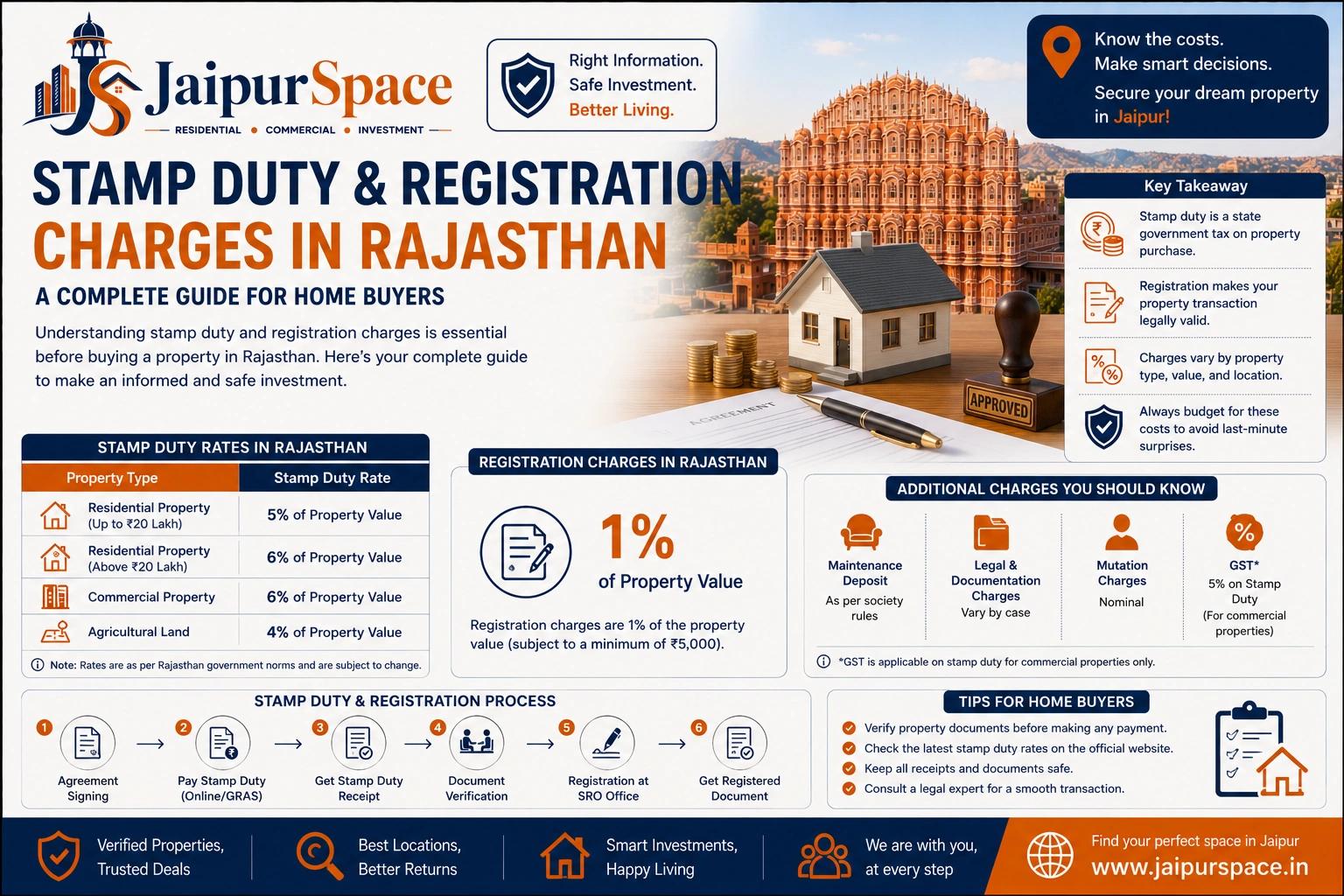
Stamp duty is a state-levied tax on property transaction documents — it's what makes your sale deed a legally valid, enforceable document. Without paying stamp duty and registering the transaction, your ownership isn't legally recognized in the way that protects you in a future dispute or resale. It's charged as a percentage of the property's value, and rates are set independently by each state.
How Stamp Duty Is Calculated
Stamp Duty vs Registration Charges — They're Different
| Factor | Stamp Duty | Registration Charges |
|---|---|---|
| What it covers | Tax on the transaction document itself ✅ | Fee for officially recording the transaction ✅ |
| Typically calculated as | Percentage of property value (higher of transaction price or circle rate) | Smaller percentage, calculated similarly |
| Paid to | State government | Sub-registrar's office |
| Applies on top of the other? | Yes — both apply together, not as alternatives ✅ | |
Who Pays What?
By standard convention and typically by law, the buyer bears stamp duty and registration charges — this is built into your overall purchase budget from the outset, not an unexpected add-on. Some negotiated deals may involve a seller contribution, but the legal responsibility and default expectation rests with the buyer.
Calculating Your Total Cost
| Cost Component | Basis |
|---|---|
| Stamp duty | Percentage of the higher of transaction value or circle rate |
| Registration charges | Smaller percentage, calculated on the same base value |
| Total additional cost | Combined percentage on top of your property price ✅ — budget for this from day one |
Because exact rates and any current concessions can change, always confirm the precise current rate with your registration office or through our team before finalizing your budget — treat any percentage figure as an estimate to verify, not a fixed constant.
Concessions & Exemptions
- Women buyers: many states, including Rajasthan, offer a concessional stamp duty rate when the property is registered solely or jointly in a woman's name — a genuine, worthwhile saving to factor into ownership structure decisions.
- Joint ownership structuring: how you structure ownership (individual vs joint, and who's named) can affect your eligible rate — worth planning deliberately rather than defaulting to whichever name comes first.
- First-time buyer schemes: occasionally available depending on current state policy — worth checking current provisions at the time of your purchase.
The Payment & Registration Process
- Confirm the current circle rate for the specific locality and property type.
- Calculate stamp duty and registration charges based on the higher of transaction value or circle rate.
- Pay stamp duty (commonly via e-stamping or the state's designated payment system).
- Book an appointment at the relevant sub-registrar's office.
- Complete registration with all parties present (or via Power of Attorney where applicable — see our NRI buying guide for remote purchase scenarios).
- Collect your registered sale deed — this is your primary proof of legal ownership going forward.
Common Mistakes to Avoid
| Mistake | Why It Causes Problems |
|---|---|
| Not budgeting for stamp duty upfront | Can create a funding gap late in the purchase process ✅ avoid by planning early |
| Assuming transaction price alone determines duty | Circle rate can push the calculation higher than expected |
| Not checking women's concessional rate eligibility | A genuine, straightforward saving left unclaimed |
| Delaying registration after paying stamp duty | Can create timing complications and isn't standard practice |
A Worked Example
To make the calculation concrete: suppose a flat has a transaction price and a government circle rate for that locality. If the transaction price is higher than the circle rate, stamp duty and registration charges are calculated on the transaction price. If the circle rate is higher instead — which can happen in fast-appreciating localities where circle rates lag actual market movement, or the reverse in some cases — the higher circle rate becomes the base for calculation regardless of what you actually agreed to pay. This is exactly why confirming the current circle rate for your specific locality before finalizing your budget matters — the two figures don't always match, and the calculation always uses whichever is higher.
Can You Get a Stamp Duty Refund?
In specific circumstances — such as a cancelled transaction before registration completes, or an overpayment due to calculation error — a refund process does exist through the state government, though it typically involves its own application and verification process. This isn't a routine expectation; treat correct calculation upfront as far more reliable than hoping to recover an overpayment later.
Stamp Duty on Gift and Inheritance Transfers
Property received as a gift or through inheritance is generally subject to different, often reduced stamp duty treatment compared to a standard sale transaction — particularly for transfers between close family members. If you're involved in such a transfer rather than a straightforward purchase, the applicable rate and process differ meaningfully from what's described above for standard buyer-seller transactions, and is worth confirming specifically with the registration office.
Frequently Asked Questions
Is stamp duty the same across all of Rajasthan?
Base rates are set at the state level, though circle rates (the minimum notified property values used in the calculation) vary by specific locality — always confirm the current circle rate for your exact area.
Do I pay stamp duty on under-construction property too?
Yes — stamp duty applies to the property transaction itself, separate from GST, which only applies to under-construction properties. Both can apply together on an under-construction purchase.
Can stamp duty be paid in installments?
Generally no — it's typically paid as a lump sum at the time of registration, which is exactly why budgeting for it upfront matters so much.
What's the women's concession on stamp duty in Rajasthan?
Many states, including Rajasthan, offer a reduced stamp duty rate when property is registered in a woman's name — confirm the current specific rate with your registration office, as provisions can be updated.
Is registration mandatory, or can I skip it and just pay stamp duty?
Registration is mandatory for the transaction to be legally recognized — stamp duty and registration are both required together, not alternatives to each other.
What happens if I under-declare the property value?
Stamp duty is calculated on whichever is higher between your declared value and the government circle rate, so under-declaring doesn't reduce liability if the circle rate is higher — it only creates a documentation mismatch.
Do resale and new launch properties have different stamp duty rates?
Stamp duty itself is calculated the same way regardless of whether the property is new or resale — see our resale vs new launch comparison for other differences between the two paths.
Can NRIs get the same stamp duty rates as resident buyers?
Generally yes — stamp duty and registration charges apply based on the property and transaction, not the buyer's residency status. See our NRI buying guide for other NRI-specific considerations.
How do I find the current circle rate for a specific area?
Circle rates are published by the state government and updated periodically — our team can help confirm the current rate for any specific locality you're considering.
Does Jaipur Space help with stamp duty and registration?
Talk to our team — we walk buyers through the full cost picture, including stamp duty and registration, before you commit to a purchase, at zero brokerage.
Budget the Full Picture, Not Just the Price Tag
Get in touch and we'll help you calculate the complete all-in cost of any property you're considering — price, GST where applicable, stamp duty, and registration, all upfront.